

The General Product Safety Regulation (GPSR) 2024
Date published:
The new General Product Safety Regulation (GPSR) came into effect on 13th December 2024. It comes to replace the previous General Product Safety Directive and the Food Imitating Product Directive. The aim of this new regulation is to address safety concerns arising from the digitisation of the economy as well as modernise the EU’s safety framework. The regulation is a major change and standardisation across the EU.
It is imperative that manufacturers, distributors, and retailers have clear and detailed comprehension of their obligations to ensure compliance, avoid penalties, and prioritise consumer safety as it covers a very wide spectrum of products.
The regulation defines a manufacturer as “…any natural or legal person who manufactures a product or has a product designed or manufactured, and markets that product under that person’s name or trademark.”
A major change and requirement is the appointment of an Authorised Representative and is defined as “…any natural or legal person established within the Union who has received a written mandate from a manufacturer to act on that manufacturer’s behalf in relation to specified tasks with regard to the manufacturer’s obligations under this Regulation.”
Key Requirements:
- Appointment of an Authorised Representative.
- Update Compliance Programs – undertake to ensure all existing safety and compliance programs meet the new GPSR regulation.
- Update all documentation and record-keeping procedures to ensure alignment with GPSR requirements. This includes traceability and incident reporting.
- Adapt and product testing and certification processes to comply with new GPSR safety standards.
- Supplier and Third-Party Management – ensure contracts and communication with suppliers and third parties are updated to ensure compliance with GPSR.
- Labelling and Consumer Information – undertake the update of all labelling and consumer information to align with the GPSR.
- Training and Awareness – implement training and awareness sessions to bring all employees and external teams up to speed with the new regulation.
- Update Data Management and IT Systems – There would be a need to upgrade all data management and IT systems to adequately support new compliance and reporting requirements.
- Incident Reporting and Corrective Actions – Update current procedures for incident reporting and corrective actions to align with GPSR protocols and where there had been none, establish a procedure.
- Market Surveillance and Consumer Feedback – where there is a system in place, this should be improved to ensure effectiveness in monitoring market compliance and safety issues as well as obtaining consumer feedback, if there is none in place, then it is imperative that one be established.
- Accountability and Traceability –economic operators must now implement stringent traceability processes to take into account digital product passport and mandatory record-keeping.
The regulation introduces a structured approach to product recalls and mandatory reporting of safety issues. It affects various product categories like furniture, clothing, kitchenware, and pet products, while excluding items regulated by other standards such as pharmaceuticals, medical devices, food.
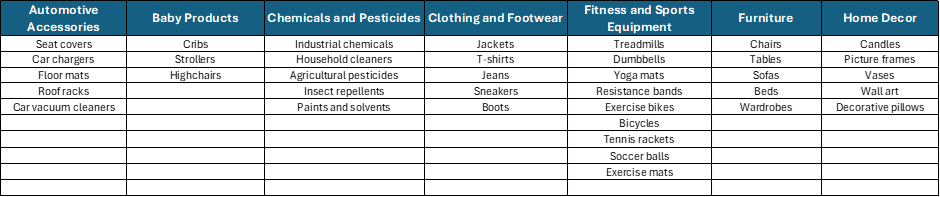
Below is a mock-up list of sectors and product range mostly impacted. This for demonstration only.

The regulation places a major responsibility for verifying and ensuring that the manufacturer has met and, complied with the requirements as set out in Articles 9(5), (6) and (7) and Article 11(3) and (4), as applicable on the distributor. It also requires the distributors to make sure that they have provided storage or transport conditions which do not compromise the conformity of the goods with the general safety requirement as enunciated in Article 5 and all other applicable Articles such as 9(5), (6), (7), 11(3) and (4).
These requirements means that all businesses in the region currently or in the process of beginning to trade with the EU must adapt and institute processes to fully comply with this updated product safety regulation, if they wish to continue to do business with the EU.